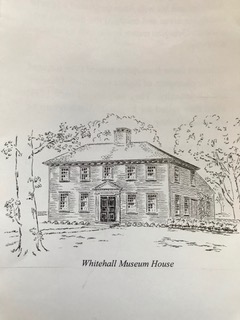
Soon after their arrival in 1729, George and Anne Berkeley purchase the Whipple farm, three miles from the center of Newport, with 96 cleared acres and a small 17th century farmhouse and outbuildings. It costs ten pounds sterling per acre, quite expensive as the land was already cleared.
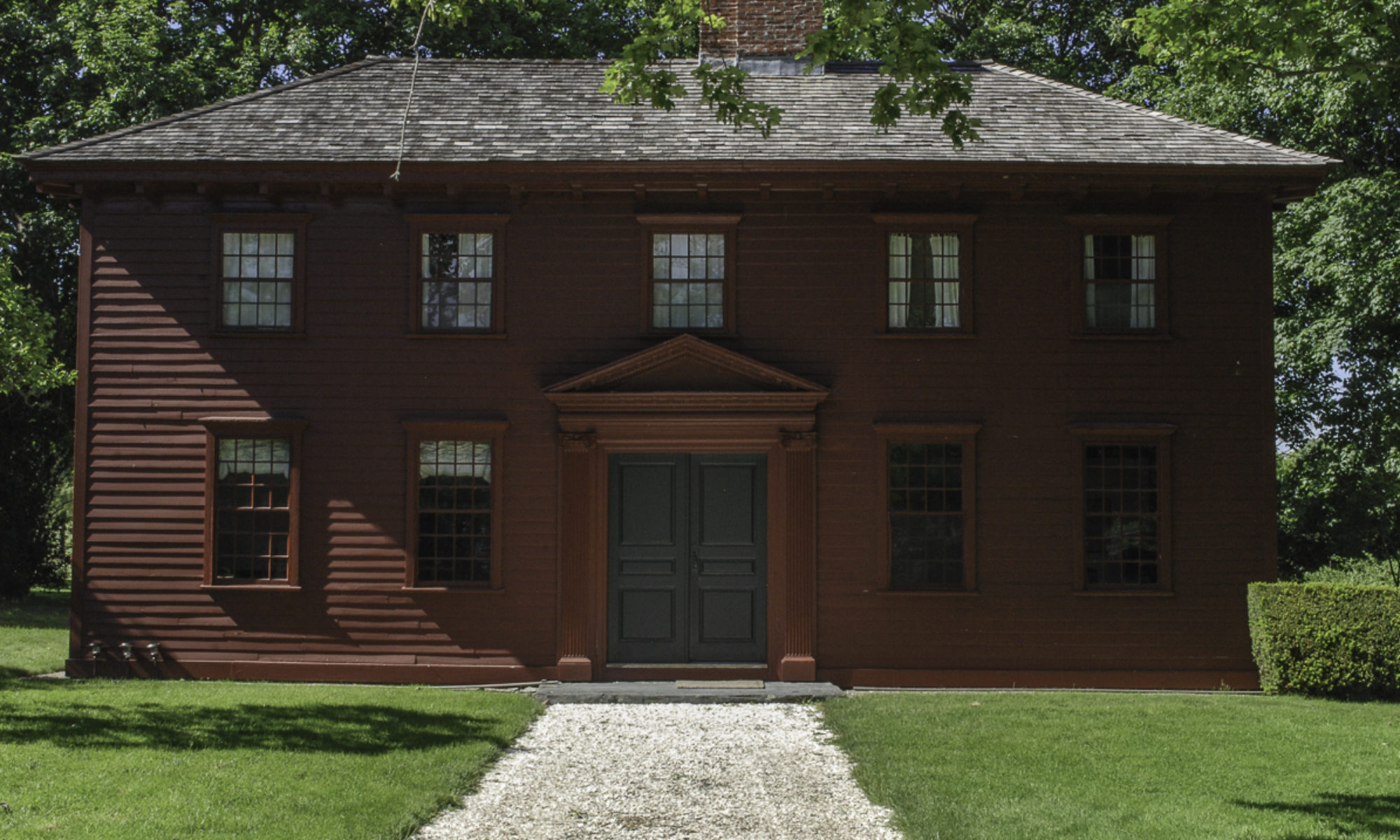
The Berkeleys enlarge the house with a new front section, designed as a small manor house in the current English taste, incorporating classical details, such as the door case and modillion cornice, which are not seen for another ten years in the colonies.
The house is designed to reflect order and good taste in a rural setting, not unlike Berkeley’s educational aim to bring the order of knowledge to primitive America.
The door case is copied from Inigo Jones’ drawings of Palladian details, published in London in 1727.
The treatment of the front doorway with its false door is an ingenious way to achieve grandeur on the exterior yet maximize space in a modest interior.
The old farm kitchen continues to serve the Berkeley family, but a new cooking fireplace is built in the cellar, where it appears the three slaves Berkeley purchases sleep on stone pallets.
Irish Delft tiles, found in the green room fireplace are thought to be all that remain of objects brought by the Berkeleys from their homes in Ireland.
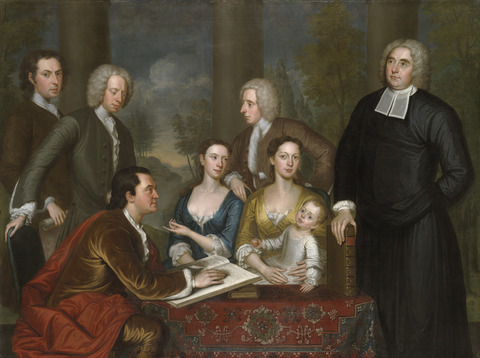
From 1729-31 Whitehall is a meeting place for the intellectual minds of New England, and the Philosophical Society— later to become the Redwood Library and Athenaeum— is born.
In 1731 the Berkeleys return to England, leaving Whitehall Farm and much of his library to Yale College. Rental income from the farm is to provide scholarships for divinity students. Before his departure, he baptizes his three slaves, but does not free them. His infant daughter, Julia is buried in Trinity churchyard. Later, GB sends a gift of an organ to the church.
For the next 160 years, the farm is leased to various tenants. It serves as an inn, a tavern, a tea house, and for most of the 19th century it is leased to a series of farmers.
The 1875 Centennial Exposition in Philadelphia, with exhibits of colonial buildings and furniture, kindles an interest in all things colonial.
For several summers during the 1870s, a young architect, Charles McKim rents a house on Washington Street in Newport, and with friends takes walking tours of coastal New England towns, sketching old buildings.
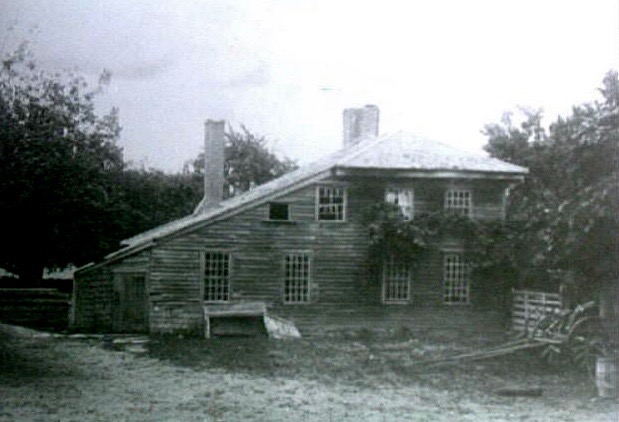
McKim hires an artist to photograph 60 colonial structures in Newport, among them, Whitehall.
In 1874 McKim’s photo of the back of Whitehall is published. It hangs over his desk during his long career as an architect. Out of this exploration of the colonial style comes a series of heavily shingled buildings designed by McKim, Mead and White which had a profound impact on other architects.
After the Civil War, Newport grows as a summer resort, and experiences a building boom. Unlike other resorts attracting new wealth, Newport remains a cultured place.
During this time Whitehall falls into great disrepair, and is considered a picturesque ruin. There is a collective memory that it was once the home of an eminent man, and it remains a picnic destination for summer folk from Newport, and their architects.
By the mid 1890s Whitehall is in danger of complete collapse. Pigs and fowl live in the ground floor rooms, while hay is stored above. In 1897, recognizing that something must be done to save the house, three Newport women raise funds to obtain a lease on the building with half an acre from Yale, and carry out a restoration. In the summer of 1899, the house is opened to the public for the first time. We have little evidence of how it was restored, except for a few exterior photos. It is one of the earliest preservation undertakings in Rhode Island.
In 1899 Whitehall is given to The National Society of The Colonial Dames of America in the State of Rhode Island, still on a 999 year lease.
From 1900 – 1924 tours were conducted by a non-resident custodian.
In 1936, with funds from the RI Tercentenary Commission, a second restoration is begun on the front two rooms, which is carefully carried out and documented by Norman Isham, a Rhode Island architect and preservationist who collaborated on the restoration of many colonial buildings, among them the Redwood Library and Athenaeum, Brick Market, and Trinity Church, as well as the building of the American Wing at the Metropolitan Museum in New York.
In 1936 the first docent/ custodians live at Whitehall during the summer months. In the post war years, more scholars and academics are in residence.
In 1975 the tenant farm family which holds the lease on the remaining acreage moves to acquire the property outright, with plans to develop it. The Dames seek unsuccessfully to stop development of the land. but are able to buy Whitehall and some back acreage. Yale releases its interest in Whitehall.
Since 1975 Whitehall continues to host members of the International Berkeley Society during the summer months. These scholars in residence live at the house in exchange for giving tours to the public.